Riding the Transpyrenees
Europe's Greatest Climb: Sam's Story

Sam Krauze was one of 400 riders selected from more than 2,000 applicants to be considered physically and mentally qualified to take on this brutal journey totally unsupported. I caught up with Sam back at home in Newbury to find out what motivated him to take on this epic challenge.
The Transpyrenees is rated as an exceptionally tough, world-class ultra-distance cycling challenge. It spans 1,126 km (700 miles) from the Atlantic Ocean to the Mediterranean Sea, packing in 26,500 m (87,000 feet) of climbing - that's more than three Mount Everests! This iconic journey traverses dozens of mythical mountain passes, including the Tourmalet, Gavarnie and Aubisque. It is rightly praised as staggeringly beautiful, taking in wild, remote valleys, high-altitude border crossings, and coastal vistas.
I started by asking Sam why he wanted to ride the Transpyrenees: he resisted the temptation to say "because it's there", instead explaining how, as a life-long cyclist he started to take on longer, touring rides just a few years ago, in his mid 20's. Part of his qualification to take part in the Transpyrenees was his 'Cycling CV' which includes 'Chase the Sun', and a 600km mountainous ride in the Belgian Ardennes. The next step had to be Europe's pinnacle ride - not the longest, but definitely the toughest.
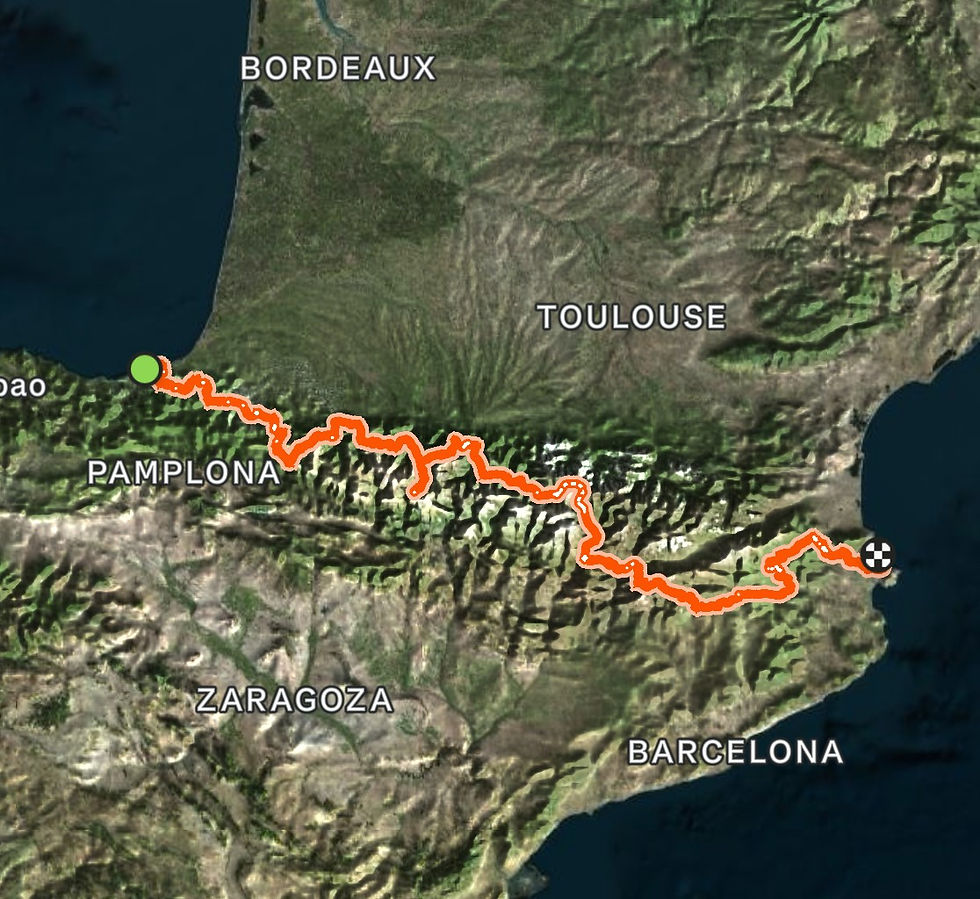
Sam's journey began at home in Newbury, packing his bike into a box for the flight to Biarritz in France. From there he'd planned to continue by train to San Sebastian in Spain but a strike on the French Railways forced him to take a taxi for the last 50km or so. After that, the timetable for the ride was simple:
27 June 16:00. Accreditation & Briefing
28 June 8:00. Start
4 July 20:00. Time limit
A time limit - yes. It's an unsupported ride with no organised provision of water, food, overnight accommodation or mechanical assistance. Participants aren't even allowed to pre-book overnight stays before they set off. For Sam, like most riders, nights were spent in a tiny bivouac tent. His only support was the GPS Tracker which allowed the organisers, plus his family and friends, to follow his progress.

Because it's a journey, not a race, all 400 cyclists started together in a small seaside village outside San Sebastian. They left in some light drizzle but during the first day the weather deteriorated dramatically.
After around 240km, on the Col de Larrau, itself an 1123m climb, violent thunderstorms broke out, along with winds so strong that another rider's bike was literally blown away. All they could do was stop and lie flat on the road until it calmed a little.
Sam then joined a small group and found shelter by 'borrowing' a shepherd's hut for the night.
It was a journey of enormous contrasts, not just in the scenery or the steep climbs and descents but emotionally too. After the obviously frightening experience of the storm and with some physical fatigue no doubt starting to emerge, on the third day came one of those uplifting moments which make it all seem worthwhile. Starting off 'feeling horrible' under heavy grey skies and with a 20 km climb ahead, was it worth all this pain? Then, three quarters of the way up he broke through the clouds into brilliant sunshine. The closest most of us get to this experience is if we're lucky enough to take a flight on a gloomy winter's morning and after a few minutes we're catapulted forwards to summer: dazzled by the light and feeling the wonderful warmth through the plane windows. That was Sam on that morning.
Riding the Storm Switchback curves Tormulet exhilaration

Despite spending up to 20 hours in the saddle every day, Sam, in his own words was "totally in the zone and properly in Spain" on the last day. The last climb of 459m to St Pere de Rodes, although beautiful, really "emptied the tanks" before a 5 km descent to the finish by the sea at Llança. Followed by a beer, lots of food and 14 hours' sleep. Then, a relaxing week on the beach with his girlfriend.
My last question had to be 'how do you follow an experience like that?' The answer was immediate, "a longer ride but definitely less climbing". Something like the Trans-Continental race - 5000km from Trondheim in Norway to Athens. Watch out for the next instalment in the Sam Krauze story.
Some statistics:
Total distance covered: 1,126.84km / 700.18 miles
Vertical ascent: 26,512m / 86,981 feet
Time in saddle: 103hr 24m
Placed: 55/252
Fastest descent: 80kmh / 50 mph
Mountain passes: 34
Calories burned: 50,000
Mechanical issues: 0
More details on Sam's journey can be found here: https://www.transiberica.club/transpyrenees/


Comments